introduction and quick run through our philosophy at our kennels and the dogs
Our story
The story and philosophy of British Bandog Kennel are closely tied to the founder's lifelong involvement with dogs and a belief that the historic Bandog should be preserved as a serious working protection dog rather than bred primarily for appearance. According to the kennel's own account, the founder grew up around Boxer dogs bred by their parents, and that early exposure sparked a long-term passion for working dogs. (british-bandog-kennel.co.uk)
Their origin story
' forge a new legacy"
by reviving the traditional role of the Bandog. They draw inspiration from medieval British Bandogs—large molosser-type guard dogs used for protection, hunting, and warfare—and aim to produce modern working Bandogs from imported European bloodlines selected for proven protection ability. (british-bandog-kennel.co.uk)
The kennel says it has sourced multi-generation working Bandogs from countries including Serbia, Slovakia, and Portugal, focusing on dogs whose parents and grandparents demonstrated real-world working performance. (british-bandog-kennel.co.uk)
Core philosophy
Their philosophy can be summarized in four principles:
1. Function before appearance
A recurring theme is that breeding decisions should prioritize working ability, protection instincts, nerve strength, and temperament rather than looks alone. This follows the same functional-breeding philosophy associated with modern Bandog developer John B. Swinford, whose work they reference indirectly through their emphasis on performance-based selection. (british-bandog-kennel.co.uk)
2. Real protection over sport protection
One of the kennel's strongest beliefs is the distinction between sport-trained protection dogs (such as IGP/Schutzhund competitors) and what they call "civil" personal protection dogs. They argue that sport dogs are often trained around equipment and structured exercises, while a true personal protection dog must be capable of recognizing and responding to real threats in everyday environments. (british-bandog-kennel.co.uk)
3. Balanced temperament
Although the kennel emphasizes power, guarding ability, and deterrence, it also stresses that these dogs should be stable companions and family protectors. Their ideal Bandog combines strong protective instincts with control, loyalty, and the ability to live successfully with its family. (british-bandog-kennel.co.uk)
4. Professional standards
The kennel highlights its use of experienced trainers and decoys, including personnel with police and protection-dog backgrounds. It presents this as evidence that selection and training are carried out to a professional standard rather than as a hobby operation. (british-bandog-kennel.co.uk)
The bigger idea behind the business
At its heart, British Bandog Kennel appears to see itself not simply as a breeder but as a custodian of a particular type of working dog. Their vision is that the Bandog should remain an "ancient guardian" adapted for modern personal and family protection roles. They position their dogs as companions that provide both security and peace of mind while preserving what they consider the historic purpose of the Bandog. (british-bandog-kennel.co.uk)


FULLY TRAINED PERSONAL PROTECTION DOGS BUILT FOR REAL WORLD SECURITY
PROFESSIONAL PROTECTION DOGS FOR INDIVIDUALS AND FAMILIES WHO REQUIRE GENUINE SECURITY _NOT SPORTS TRAINED SUBSTITUTES
ENQUIRIE NOW
LEARN MORE
For any questions or inquiries, feel free to reach out to us at:
info@british-bandog-kennel.co.uk

WHAT IS A BANDOG
The term "Bandog" in medieval Britain was not a specific breed but a descriptive term for a type of large, powerful working dog, typically a Mastiff or similar molosser-type dog, which was kept chained or "banded" during the day and released at night to guard property.
History and Usage
Origin of the Term: The word "bandogge" originated around 1250–1300 in Middle England and is thought to derive from the Old Saxon word "banda" (chain) and "doc" (dog), literally meaning "chained dog". This highlights their primary management method rather than their genetic lineage.
Physical Description: Historical accounts describe them as "huge dogs, stubborn, uglier, eager, burthenouse of bodie, terrible and fearful to behold". They were selected for their strength, stamina, confidence, and fearlessness.
Primary Roles:
Guarding and Protection: Their main use was to guard and protect homesteads, farms, and properties from intruders and poachers at night.
Hunting: They were employed for hunting large game, such as wild boar and even for locating poachers.
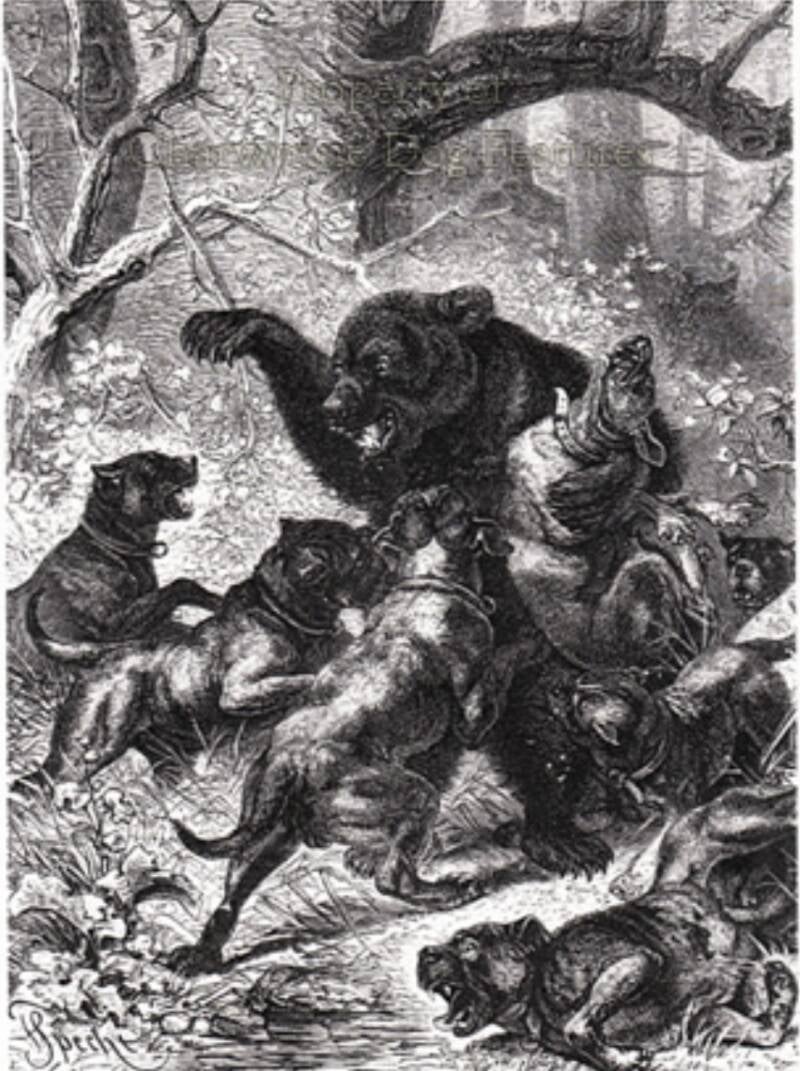
Baiting: In later medieval and early modern periods (around the 16th century), they were also used in blood sports like bull-baiting and bear-baiting.
Other Tasks: Dr. Johannes Caius mentioned in 1576 that they were "serviceable against the fox and the badger, to drive wild and tame swine out of meadows, and pastures".
Ancestry and Legacy
The original medieval Bandogs were working dogs of various crosses and sizes, without a unified breed standard. They typically descended from eastern shepherds and mastiffs crossed with western Bullenbeissers and hounds.